Why Homes No Longer Feel Restful Despite Comfort and Technology.
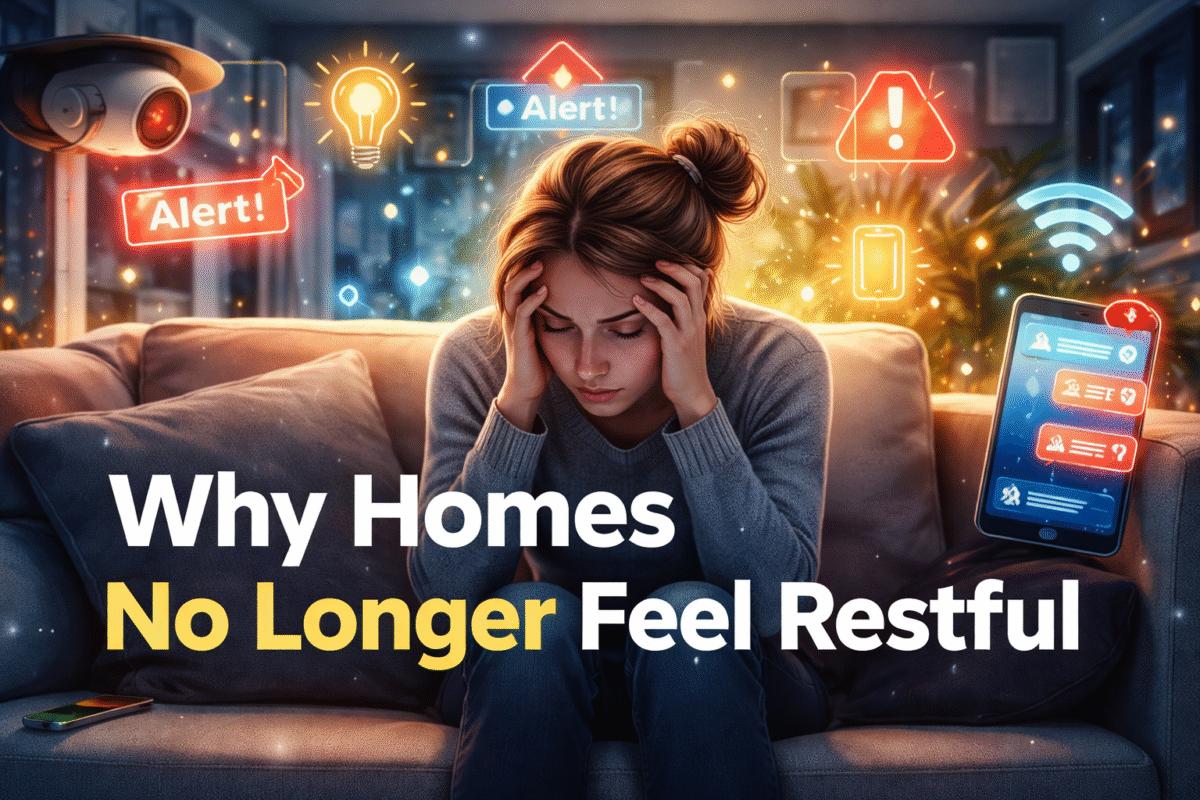
Why homes no longer feel restful is a question many people sense emotionally but rarely articulate. In 2026, more people than ever describe feeling tense, distracted, or mentally exhausted—despite spending more time at home than previous generations.
Homes were once designed to be places of refuge. They represented safety, silence, and emotional recovery. Yet today, the modern home has quietly transformed into something else: a space filled with alerts, expectations, digital noise, and invisible pressure.
When Home Stopped Being a Sanctuary
To understand why homes no longer feel restful, we need to look beyond technology itself and examine how the meaning of “home” has changed. Historically, the home was separate from work, public life, and constant stimulation.
Today, that boundary has almost completely disappeared. The same room where we sleep is often where we work, scroll, watch news, answer messages, and make decisions. There is no longer a clear mental signal that tells the brain: you are safe to rest now.
Modern homes are full of invisible demands. Notifications, reminders, digital calendars, smart devices, emails, and background noise constantly signal that something needs attention. Even when nothing urgent is happening, the possibility that something might happen keeps the nervous system alert.
The Silent Role of Constant Connectivity
One of the biggest reasons why homes no longer feel restful is constant connectivity. Being connected sounds harmless—even beneficial—but the human brain was not designed for uninterrupted access to information.
Connectivity removes natural pauses. In previous decades, being at home meant being temporarily unreachable. Today, the home is often the most connected place of all.
Common signs of connectivity overload at home:
- Feeling restless even when sitting or lying down
- Checking your phone without a clear reason
- Difficulty relaxing without background content
- Feeling mentally “on” all the time
These symptoms are not signs of laziness or lack of discipline. They are predictable responses to environments that never fully power down. When the brain cannot identify a safe stopping point, rest becomes shallow and fragmented.
Why Silence Now Feels Uncomfortable
Another overlooked reason why homes no longer feel restful is our changing relationship with silence. Silence used to be normal. Today, it often feels uncomfortable or even unsettling.
Many homes are filled with continuous sound: TVs playing in the background, podcasts, notifications, appliances, or ambient digital noise. Silence has been replaced by constant low-level stimulation.
Ironically, this constant stimulation prevents real relaxation. True rest requires moments where the brain does not need to interpret, respond, or prepare.
The Psychological Weight of “Always Available” Living
Availability has become a default expectation. Messages are expected to be answered quickly. Emails arrive at all hours. Social platforms never close. This expectation follows people into their homes.
As a result, the home is no longer a psychological boundary. It becomes an extension of public life, social responsibility, and performance.
This explains why so many people report feeling tired even after spending entire weekends at home. Physical presence at home does not automatically create mental rest.
Understanding why homes no longer feel restful is not about blaming technology or modern life. It is about recognizing that our environments shape our nervous systems more than we realize.
Related Guides You May Find Useful
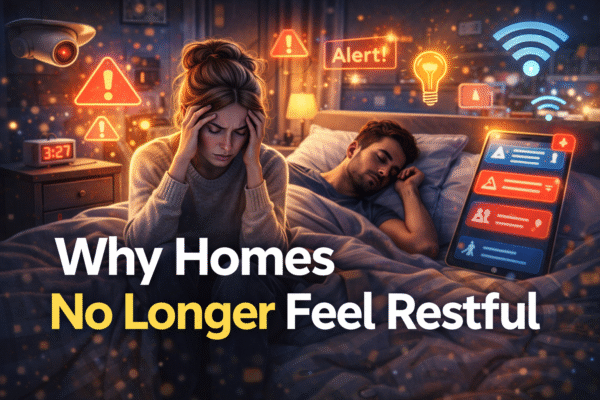
When Smart Home Technology Stops Feeling Smart
Smart home devices are supposed to simplify life. That’s the promise. Automation, voice control,
AI-driven routines, and seamless integrations are marketed as tools that remove friction from daily living.
But for many users, the reality feels very different.
Instead of peace, smart homes can quietly introduce a new kind of cognitive pressure. Notifications stack up.
Apps multiply. Updates break routines. Devices demand attention. And before you realize it, technology that was
meant to help you is competing for your mental energy.
A smart home should reduce decisions, not create more of them. When it does the opposite,
it’s a sign that optimization has turned into overload.
The Hidden Cost of Too Many Smart Devices
One of the most overlooked aspects of smart home adoption is the cumulative mental cost.
Each device on its own feels manageable. A smart plug here, a camera there, maybe a voice assistant
controlling lights or temperature.
The problem starts when these systems don’t communicate smoothly or when each one introduces its own ecosystem.
Separate dashboards. Separate alerts. Separate rules. Suddenly, instead of one intelligent environment,
you’re managing multiple mini-systems.
This is something I’ve seen repeatedly while testing and reviewing devices across different categories.
As explained in my testing process, usability over time matters more than features on day one.
Devices that feel exciting initially can become sources of friction weeks later.
Why Notifications Are the Real Enemy
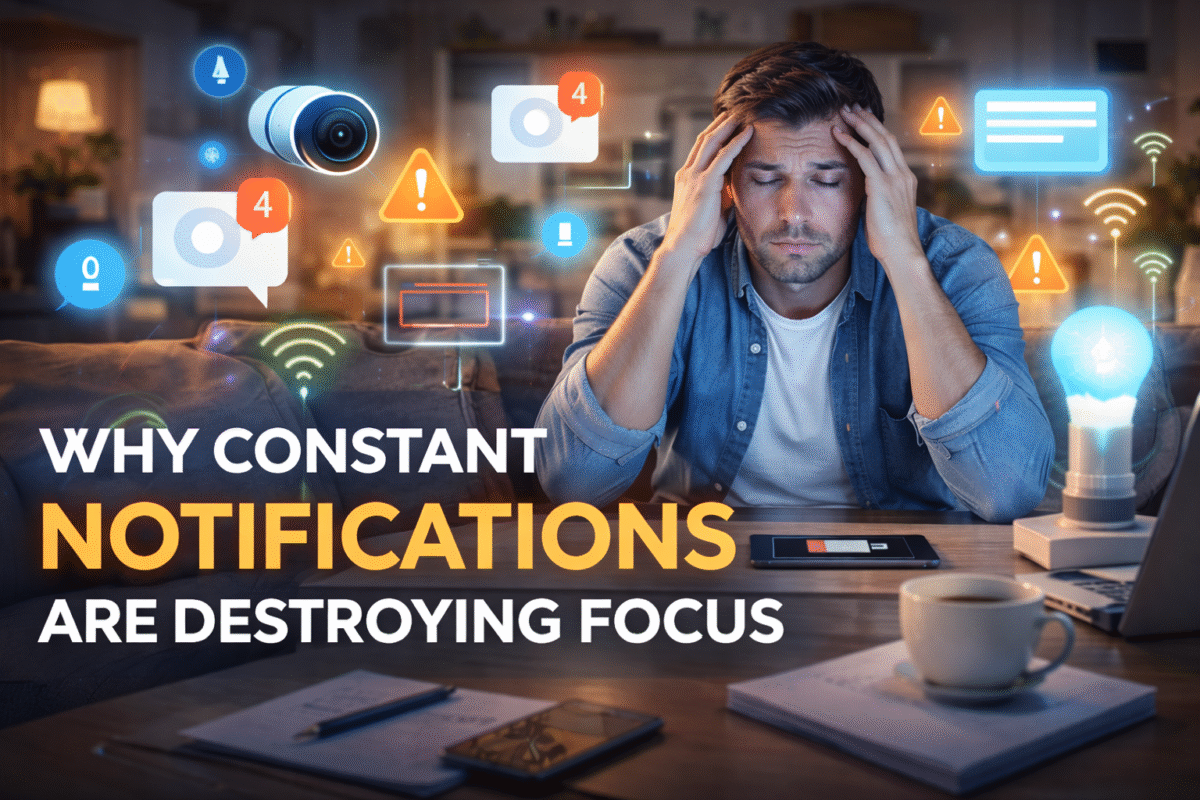
Notifications are designed to inform, but in smart homes they often do the opposite.
Motion detected. Device offline. Firmware update available. Routine failed.
Individually, these alerts seem harmless. Collectively, they fragment attention and increase background stress.
This effect is closely tied to what many users experience as technology anxiety at home.
Common Notification Triggers
- Wi-Fi instability causing device disconnects
- Security cameras sending false motion alerts
- Apps requesting permissions or re-authentication
- Automations failing silently until something breaks
Complexity Masquerading as Intelligence
Many smart home ecosystems reward complexity. The more routines you build, the more “advanced”
your setup appears. But complexity doesn’t always equal intelligence.
A truly smart system fades into the background. You don’t think about it. You don’t manage it daily.
It simply works. When a system requires constant tweaking, checking, or troubleshooting,
it has failed its core purpose.
This is why choosing the right devices from the beginning matters so much.
Buying fewer, well-integrated products often delivers better long-term results
than chasing every new release under $100.
Signs Your Smart Home Is Creating Mental Overload
- You regularly ignore smart home notifications
- You forget which app controls which device
- You hesitate to add new devices due to setup fatigue
- You feel relief when something is unplugged or disabled
These signals are subtle but important. They indicate that the system is demanding
attention instead of conserving it.
Designing a Smarter, Quieter Smart Home
Reducing smart home mental overload doesn’t require abandoning technology.
It requires intentional design.
Start by auditing your current setup. Identify devices that provide real value
versus those that simply generate data or alerts. Simplify routines.
Consolidate platforms whenever possible.
The goal isn’t maximum automation. The goal is minimum cognitive effort.
A calm smart home is one you rarely think about.
Follow Us for Practical Tech Insights
We focus on real-world technology use, not hype. Follow us for honest reviews,
buying guides, and thoughtful takes on how tech affects daily life.
What Actually Causes Smart Home Mental Overload?
Smart home mental overload doesn’t happen overnight. It builds slowly,
often disguised as convenience. Most users don’t realize what’s happening until their
smart home starts feeling noisy, demanding, or emotionally draining.
The issue is rarely a single device. Instead, smart home mental overload
emerges from the interaction between systems, expectations, and human attention.
Understanding the real causes is the first step toward regaining control.
1. Too Many Control Points, Not Enough Clarity
One of the biggest contributors to smart home mental overload is fragmented control.
When lights, cameras, thermostats, and appliances all rely on different apps,
the home stops feeling unified.
Each app demands mental context: Where do I change this setting? Which app sent that alert?
Is this device offline or just lagging? Over time, this constant micro-decision-making
increases cognitive fatigue.
What should feel automated instead becomes something you actively manage.
That’s not intelligence — that’s workload.
2. Automation That Requires Supervision
Automation is supposed to reduce effort. But poorly designed automations are a core driver
of smart home mental overload.
Routines that fail silently, triggers that misfire, or automations that behave differently
depending on time, location, or updates all force users into a monitoring role.
If you regularly check whether an automation worked, it’s not reducing effort —
it’s adding background stress.
This constant low-level checking is a classic symptom of smart home mental overload,
closely tied to broader technology anxiety at home.
3. Alert Fatigue and False Urgency
Smart homes are very good at signaling problems — even when those problems aren’t real.
Motion alerts, connectivity warnings, update notifications, and “action required” messages
create a sense of urgency that rarely matches reality.
Over time, the brain learns to treat these signals as noise. This paradoxically increases
smart home mental overload: either you react too often, or you stop trusting
the system altogether.
Both outcomes create stress. One demands constant attention. The other creates anxiety
about missing something important.
4. Feature Creep Masquerading as Progress
New features are marketed as improvements, but feature creep is a silent contributor
to smart home mental overload.
Interfaces change. Settings move. Simple toggles become nested menus.
Voice commands gain complexity. What used to be intuitive now requires relearning.
This is especially problematic in shared households, where not everyone interacts
with the system in the same way. A “smart” home should feel accessible to everyone,
not optimized for power users only.
5. The Emotional Weight of Constant Optimization
There’s an unspoken pressure in smart home culture: the idea that your setup
could always be better. More efficient. More automated. More advanced.
This mindset fuels smart home mental overload by turning living spaces
into ongoing projects instead of places of rest.
When your home feels like a system that’s never finished, it becomes harder to relax inside it.
Technology anxiety at home often starts here — not with devices failing, but with expectations.
Why This Matters More Than You Think
Smart home mental overload doesn’t just affect convenience.
It affects mood, patience, and decision-making.
Homes are supposed to be psychologically safe spaces. When technology introduces
constant input, evaluation, and alerts, that sense of safety erodes subtly but steadily.
Recognizing these causes isn’t about rejecting smart technology.
It’s about redefining what “smart” should actually mean.
How to Reduce Smart Home Mental Overload Without Giving Up Technology
Reducing smart home mental overload is not about removing devices.
It’s about removing friction. A smart home should lower cognitive effort,
not increase it.
The key difference between a helpful smart home and one that creates
smart home mental overload is intentional design.
Below is a practical framework you can apply immediately.
1. Define a Single Purpose for Every Smart Device
One of the fastest ways to reduce smart home mental overload
is to stop expecting devices to do everything.
Each smart device should have one primary role.
When devices serve multiple overlapping purposes,
they create confusion, duplicated alerts, and unnecessary complexity.
If your smart speaker controls lights, reminders, alarms, news, and notifications,
you’re increasing the risk of smart home mental overload.
Limiting its role immediately reduces mental friction.
2. Cut Notifications Before You Optimize Automations
Notifications are the biggest accelerant of smart home mental overload.
Before creating new routines, remove unnecessary alerts.
Ask one question for every notification:
Does this require immediate action?
If the answer is no, it should not interrupt your attention.
Reducing notification volume alone can dramatically lower
smart home mental overload and technology anxiety at home.
3. Favor Predictability Over Intelligence
A predictable system reduces smart home mental overload
more effectively than an advanced one.
Simple schedules outperform complex conditional automations.
The brain relaxes when it knows what will happen,
without guessing or checking.
If an automation behaves differently depending on location, time,
presence detection, or recent activity, it may be technically impressive,
but psychologically expensive.
4. Centralize Control to Reduce Cognitive Switching
App switching is a hidden driver of smart home mental overload.
Every time you move between apps, your brain reloads context.
Whenever possible, centralize control into one interface.
This reduces decision fatigue and lowers the mental cost
of interacting with your home.
Fewer control surfaces = less smart home mental overload,
even if the underlying system stays the same.
5. Design for Silence, Not Constant Feedback
A healthy smart home is quiet most of the time.
Silence is a signal that things are working.
Designing for silence directly reduces
smart home mental overload
and prevents alert fatigue.
If your system constantly reports its status,
it forces you into a supervisory role.
Your home should support your life,
not demand attention.
6. Periodic Subtraction Beats Constant Upgrades
Instead of adding new features, schedule moments of subtraction.
Removing unused automations and devices lowers
smart home mental overload
faster than adding anything new.
This practice also reduces technology anxiety at home
and restores the feeling that your space belongs to you,
not to the system.
The Goal: A Home That Thinks Quietly
The opposite of smart home mental overload
is not a “dumb” home.
It’s a home that works quietly in the background.
When smart technology fades into the environment,
mental space returns.
That’s when a smart home truly becomes smart.
Smart Home Mental Overload: Practical Ways to Reduce Cognitive Stress at Home
Smart home mental overload happens when technology designed to simplify life
starts demanding attention instead of saving it.
This section focuses exclusively on reducing smart home mental overload
through practical, repeatable changes.
If your smart home feels noisy, distracting, or mentally exhausting,
you are already experiencing smart home mental overload,
even if everything is technically working.
Why Smart Home Mental Overload Builds Up Over Time
Smart home mental overload rarely appears overnight.
It accumulates slowly as devices, notifications, automations,
and control apps increase.
Every additional alert, routine, or smart feature adds cognitive weight.
Over time, this weight turns into smart home mental overload,
even in well-designed systems.
Smart home mental overload is not a technical failure.
It is a psychological response to excessive interaction, choice,
and constant system feedback.
The Link Between Notifications and Smart Home Mental Overload
Notifications are the strongest trigger of smart home mental overload.
Each notification forces your brain to evaluate urgency,
relevance, and action.
When smart homes generate frequent notifications,
they create a permanent low-level stress response,
reinforcing smart home mental overload throughout the day.
- Security alerts that don’t require action
- Status updates with no consequence
- Routine confirmations that interrupt focus
Reducing these alerts immediately lowers
smart home mental overload
without changing any hardware.
How Complexity Multiplies Smart Home Mental Overload
Complexity is a multiplier of smart home mental overload.
The more conditions an automation has,
the more mental energy it requires to trust.
Users dealing with smart home mental overload
often check apps repeatedly because systems feel unpredictable.
Predictability, not intelligence, is what reduces overload.
If an automation requires explanation,
it contributes to smart home mental overload.
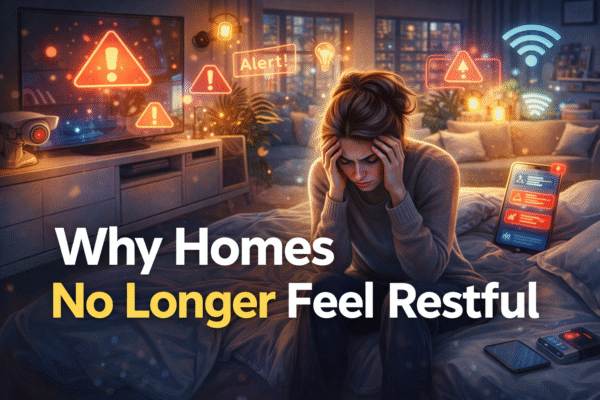
Decision Fatigue Inside Smart Homes
Decision fatigue is a core component of
smart home mental overload.
Multiple apps, dashboards, and control methods
force constant micro-decisions.
Choosing where to control lights, climate, or security
may seem trivial, but repeated decisions amplify
smart home mental overload over time.
Centralizing control reduces decision fatigue
and directly lowers smart home mental overload.
Silence as a Solution to Smart Home Mental Overload
Silence is one of the most effective treatments for
smart home mental overload.
A system that only speaks when necessary
allows mental recovery.
Homes that operate quietly create trust.
Trust eliminates constant checking,
which is a major contributor to
smart home mental overload.
Reducing Smart Home Mental Overload Without Removing Devices
You don’t need fewer devices to solve
smart home mental overload.
You need fewer interruptions.
When smart systems fade into the background,
smart home mental overload
is replaced by a sense of control and calm.
The ultimate goal is not a smarter home,
but a quieter mind.
That is the true opposite of
smart home mental overload.
🔥 Join 120,000+ Smart Shoppers!
Get exclusive gadget deals, viral Amazon finds and tech reviews before they trend. Only the best — straight to your inbox every week 🚀