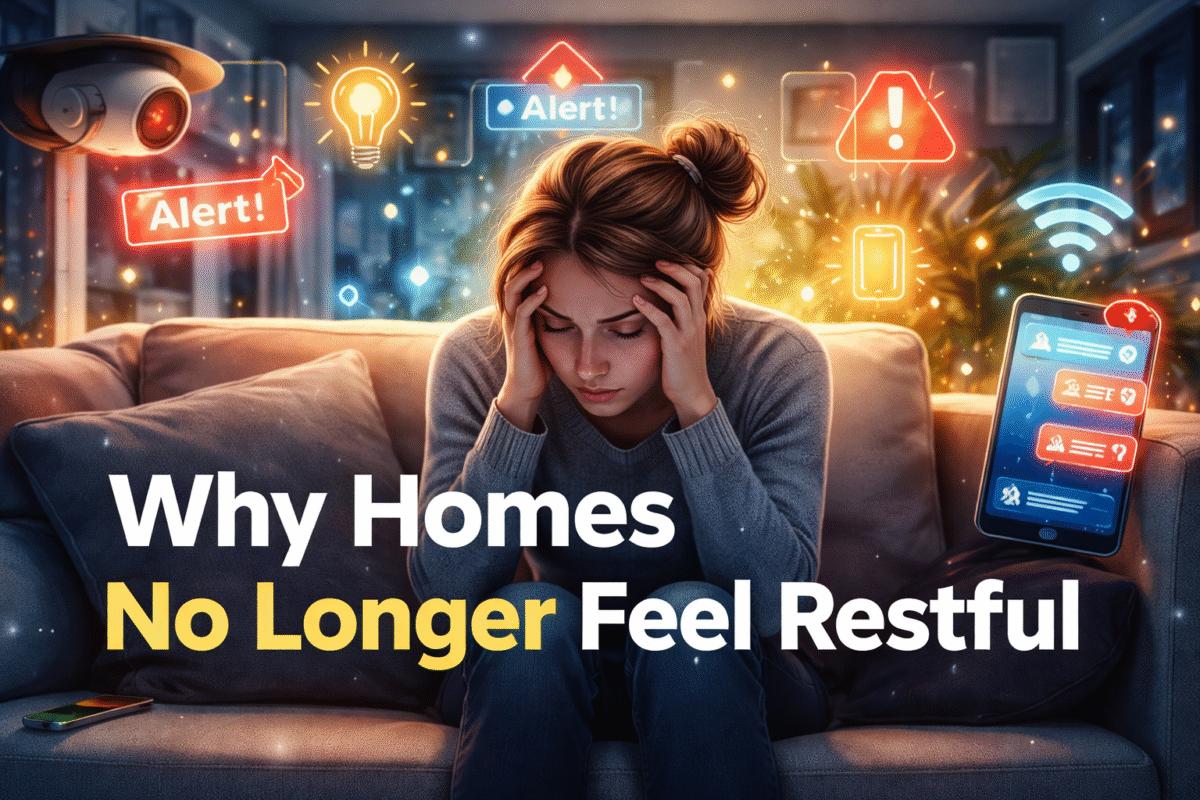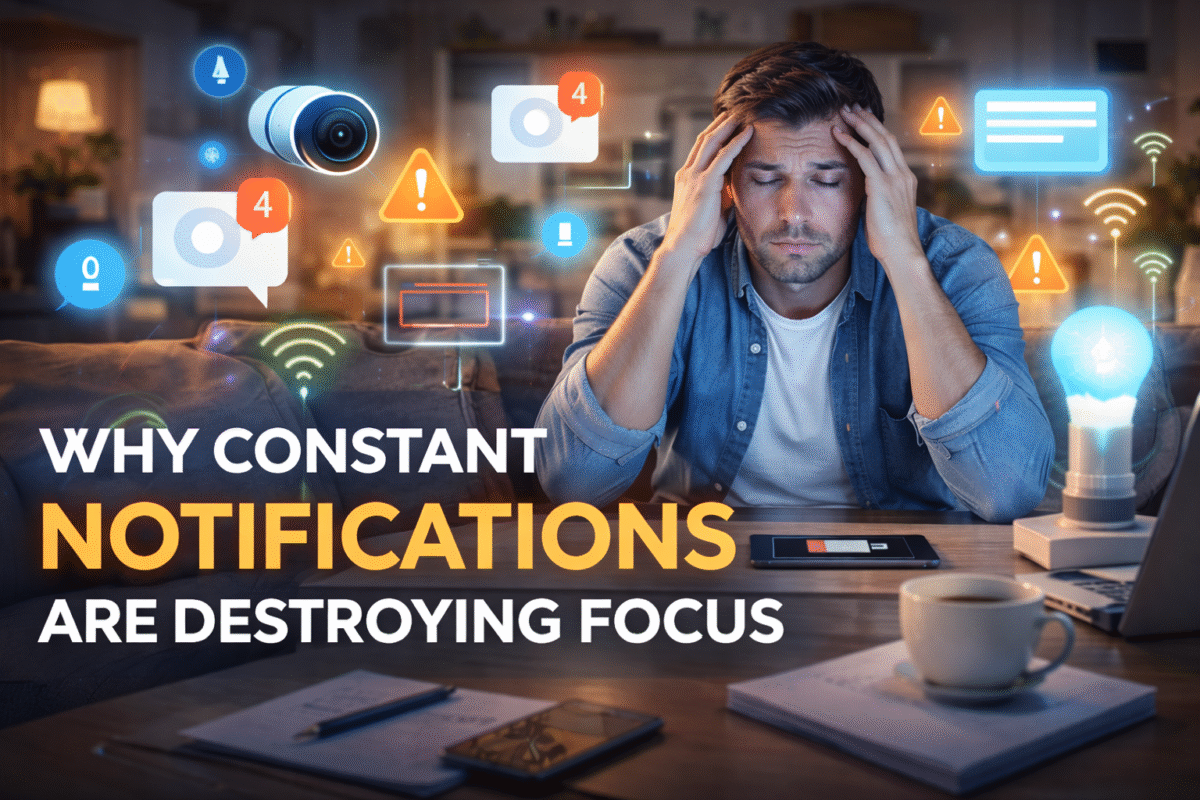
Why Constant Notifications Are Destroying Focus
The Hidden Cost of Always Being Online
Smartphones, apps, emails, smart devices — modern technology was designed to make life easier.
Yet for millions of people, the endless stream of notifications has created a new problem:
constant mental distraction.
From work emails arriving at midnight to social media alerts every few minutes,
notifications are silently reshaping how our brains work — and not in a good way.
📲 The Age of Constant Interruptions
We live in a world where silence is rare. Phones vibrate, watches buzz, laptops chime,
and apps compete aggressively for attention. According to multiple behavioral studies,
the average person receives dozens — sometimes hundreds — of notifications per day.
While each alert may seem harmless on its own, the cumulative effect is powerful.
Every notification interrupts focus, breaks concentration, and forces the brain to switch tasks.
is enough to disrupt your mental flow.
This phenomenon is known as attention residue — when part of your mind remains stuck
on the interruption even after returning to the original task.
🧠 How Notifications Rewire the Brain
Notifications don’t just interrupt — they condition behavior. Each alert triggers a small
dopamine response, encouraging us to check our devices repeatedly. Over time, this creates
a feedback loop where the brain becomes dependent on constant stimulation.
Instead of deep focus, the brain adapts to short bursts of attention. Tasks feel harder,
concentration feels exhausting, and boredom becomes uncomfortable.
Signs Your Focus Is Being Affected
- Difficulty concentrating for long periods
- Feeling mentally tired despite little physical effort
- Compulsive phone-checking without purpose
- Reduced ability to complete deep or creative work
⏱️ The Productivity Myth
Many people believe being constantly reachable makes them more productive.
In reality, studies consistently show the opposite.
Switching between tasks — even briefly — increases error rates, slows completion time,
and raises stress levels. What feels like “staying connected” often turns into
fragmented productivity.
This is especially noticeable in remote work environments, where notifications from
messaging apps, emails, calendars, and project tools overlap continuously.
Related Reading
📉 Mental Health and Always Being Online
Beyond productivity, constant notifications have a direct impact on mental well-being.
Research links frequent interruptions to increased anxiety, irritability, and emotional fatigue.
The pressure to respond immediately creates a sense of urgency that never fully disappears.
Even during rest, the brain remains in a semi-alert state.
Over time, this contributes to burnout — not because of workload, but because
the mind never truly disconnects.
🧠 How Constant Notifications Gradually Rewire the Brain
Constant notifications do more than interrupt daily tasks — they slowly change how the brain processes attention, reward, and stress.
Unlike older forms of distraction, digital notifications are unpredictable, personalized, and emotionally charged, which makes them far more powerful.
Each alert represents a potential reward: a message, a social interaction, a piece of information, or a sense of urgency.
This unpredictability activates the brain’s reward system, reinforcing the habit of frequent checking.
Over time, this conditioning reshapes attention patterns. The brain becomes optimized for reacting rather than focusing.
Deep, uninterrupted concentration begins to feel unnatural, even uncomfortable.
🔁 Dopamine Loops and Digital Conditioning
Dopamine is often misunderstood as a “pleasure chemical,” but in reality, it drives motivation and anticipation.
Notifications exploit this mechanism by delivering small, uncertain rewards.
Because alerts arrive at irregular intervals, the brain learns to stay in a heightened state of anticipation.
This is the same psychological mechanism used in slot machines and gambling systems.
The result is a compulsive checking behavior that feels automatic rather than intentional.
Many people unlock their phones without a clear purpose, responding to habit rather than need.
This pattern doesn’t require excessive screen time to be effective.
Even short, frequent interactions reinforce the loop, keeping the brain in a constant state of alertness.
🧩 Fragmented Attention and Cognitive Switching Costs
Every time a notification pulls attention away from a task, the brain incurs a cognitive cost.
This is known as task-switching overhead.
Switching between tasks forces the brain to reorient, reload context, and regain momentum.
Even brief interruptions can result in several minutes of reduced efficiency afterward.
When notifications occur repeatedly throughout the day, focus never fully stabilizes.
Instead of entering deep concentration, the brain remains in a shallow, reactive mode.
This fragmented attention affects complex thinking the most.
Activities that require planning, creativity, or problem-solving suffer significantly under constant interruption.
Cognitive Effects Linked to Frequent Notifications
- Reduced working memory capacity
- Lower problem-solving efficiency
- Increased mental fatigue
- Shortened attention span
⚠️ Stress Response and Mental Overload
Notifications are not neutral signals. Many carry emotional weight: urgency, expectation, or social pressure.
Work messages imply responsibility, social alerts imply validation, and system notifications imply action.
Each alert triggers a mild stress response as the brain evaluates importance and urgency.
While one alert may be insignificant, repeated activation of this response throughout the day leads to cumulative stress.
The nervous system never fully returns to baseline.
This low-level stress becomes the default state, even during rest periods.
Over time, this contributes to feelings of mental overload, irritability, and difficulty relaxing.
The brain remains in “response mode” rather than recovery mode.
🧠 Reduced Capacity for Deep Thinking
Deep thinking requires uninterrupted time and cognitive stability.
When notifications are frequent, the brain adapts by prioritizing speed over depth.
This adaptation affects how information is processed.
Instead of forming long, coherent thought chains, the brain favors quick reactions and surface-level scanning.
As a result, tasks that once felt manageable begin to feel overwhelming.
Reading long articles, engaging in thoughtful conversations, or learning complex skills becomes more difficult.
This shift is subtle and gradual, which makes it hard to recognize.
Many people attribute reduced focus to stress or aging, without realizing the role constant notifications play.
📉 Long-Term Behavioral Changes
Over months or years, the effects of constant notifications extend beyond attention.
Behavioral patterns begin to shift in noticeable ways.
People may avoid tasks that require sustained effort, favoring quick interactions instead.
Procrastination increases, not due to laziness, but due to reduced cognitive endurance.
Boredom becomes uncomfortable, leading to compulsive device use even during moments of rest.
Silence feels empty rather than restorative.
These changes are not irreversible, but they require awareness and intentional adjustment.
Understanding how notifications affect the brain is the first step toward reclaiming focus.
📱 How Constant Notifications Affect Daily Life, Productivity, and Emotional Well-Being
The impact of constant notifications doesn’t stay confined to the brain — it spills into everyday life.
Over time, the always-online mindset reshapes routines, habits, relationships, and even how people perceive their own productivity.
What begins as convenience slowly turns into cognitive noise.
Days feel busier, attention feels scattered, and rest feels less restorative.
⏳ The Illusion of Productivity
Notifications create a powerful illusion: the feeling of being productive without actually accomplishing meaningful work.
Responding to messages, clearing alerts, and checking updates feels active, even urgent.
However, these micro-actions rarely contribute to long-term goals.
They consume time and energy while providing little sense of completion.
This creates a cycle where people feel busy all day but struggle to identify tangible progress by the evening.
The mind equates responsiveness with productivity, even when deeper work is postponed.
Common Productivity Side Effects
- Difficulty starting focused tasks
- Constant task hopping
- Lower quality output
- End-of-day mental exhaustion
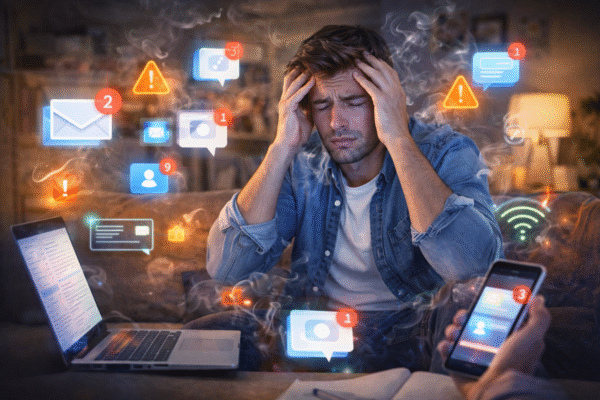
🧠 Mental Fatigue and Decision Overload
Every notification requires a decision: ignore it, respond now, or postpone.
These decisions accumulate throughout the day, contributing to decision fatigue.
As mental resources are depleted, even simple choices feel draining.
People may struggle to prioritize, hesitate more often, or default to the easiest option.
This fatigue doesn’t disappear after work hours.
It follows people into the evening, affecting personal time, family interactions, and rest.
By the end of the day, the brain is overstimulated yet unsatisfied — tired but restless.
😟 Emotional Impact and Low-Level Anxiety
Constant notifications create a background sense of urgency.
Even when alerts are benign, they reinforce the idea that something always needs attention.
This persistent state of readiness can lead to subtle anxiety.
People feel uneasy when their phones are silent, yet overwhelmed when they’re active.
The fear of missing something important — information, opportunities, or social connections — keeps the mind tethered to the device.
Over time, this erodes emotional resilience.
Moments that once felt calm now feel incomplete without digital input.
Emotional Patterns Linked to Notification Overload
- Restlessness during quiet moments
- Difficulty relaxing without devices
- Irritability from frequent interruptions
- Reduced emotional presence
👨👩👧 Social Disconnection in an Always-Connected World
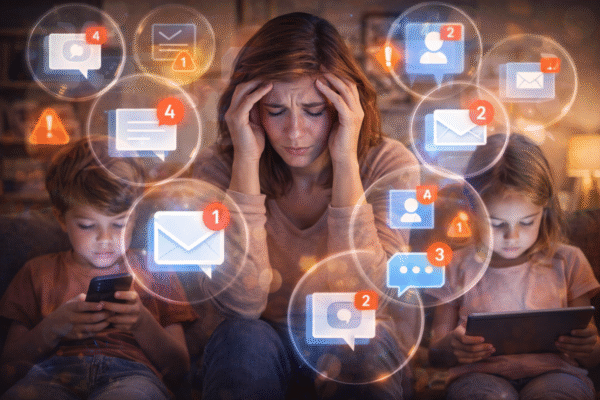
Ironically, constant digital connection can weaken real-world relationships.
Notifications interrupt conversations, meals, and shared experiences.
Even brief glances at a phone break the flow of interaction.
Over time, this reduces emotional intimacy and perceived attentiveness.
People may be physically present but mentally elsewhere, divided between the moment and the device.
This partial attention affects how relationships are experienced and remembered.
In family settings, this pattern becomes normalized.
Children and adults alike learn that interruptions are expected, even during meaningful moments.
🌙 The Impact on Rest and Recovery
Notifications don’t stop affecting the mind after sunset.
Even when devices are put away, mental stimulation lingers.
Late-night alerts disrupt wind-down routines and interfere with sleep quality.
Anticipation of messages can delay relaxation, making it harder to transition into rest.
Poor recovery compounds daily fatigue.
Without adequate mental rest, attention and emotional regulation suffer the following day.
This creates a feedback loop: fatigue reduces focus, which increases reliance on notifications, which further disrupts rest.
⚙️ Why Modern Digital Systems Are Built Around Constant Interruptions
To understand why notifications dominate modern life, it’s important to look beyond individual habits.
The issue is not personal weakness — it’s structural design.
Most digital platforms are built within what experts call the attention economy, where human focus is the most valuable resource.
Notifications are not accidental; they are strategic.
📊 The Attention Economy Explained
In traditional industries, value is created through products or services.
In digital ecosystems, value is often generated through attention.
The longer users stay engaged, the more data is generated, the more ads are viewed, and the more interactions occur.
Notifications act as entry points that pull users back into platforms repeatedly.
This model rewards frequency over depth.
A platform benefits more from ten short visits than one long, focused session.
As a result, systems are optimized for interruption rather than concentration.
Why Interruptions Are So Effective
- They re-engage users instantly
- They trigger emotional responses
- They create habitual checking behavior
- They reduce the chance of disengagement
🔔 Notifications as Behavioral Triggers
Notifications are designed to bypass rational decision-making.
They rely on urgency, curiosity, and social relevance.
Words like “new,” “missed,” or “waiting” activate instinctive responses.
Even neutral alerts carry implicit pressure to respond.
Visual cues — badges, colors, vibrations, sounds — reinforce this effect.
Together, they form a system that competes for attention throughout the day.
Importantly, these triggers are personalized.
Algorithms learn which notifications users respond to most and prioritize them.
📱 Social Expectations and Digital Pressure
Beyond platform design, social norms reinforce constant availability.
Quick replies are often interpreted as politeness, professionalism, or care.
Delayed responses may be perceived as disinterest, even when boundaries are intentional.
This creates unspoken pressure to stay responsive.
Work culture amplifies this effect.
Messaging tools blur the line between working hours and personal time.
As availability becomes normalized, disconnection begins to feel like deviation.
The Social Cost of Always Being Reachable
- Reduced personal boundaries
- Increased expectation of instant replies
- Difficulty disconnecting without guilt
- Blurred work–life separation
🧠 Why Awareness Matters More Than Avoidance
The goal is not to reject technology.
Digital tools provide real benefits when used intentionally.
The problem arises when systems dictate behavior instead of supporting it.
Awareness allows individuals to regain agency.
By recognizing that constant notifications are a design outcome — not a personal failure — people can begin to make conscious adjustments.
This shift in perspective reduces guilt and empowers intentional use.
🌿 Reclaiming Focus Without Disconnecting: Healthier Ways to Live With Notifications
Living in a connected world doesn’t require constant disengagement.
The solution to notification overload isn’t elimination — it’s intentional interaction.
Many people successfully regain focus by adjusting how, when, and why notifications enter their daily lives.
Small shifts often create meaningful relief.
🔕 Redefining What Deserves Immediate Attention
Not all notifications are equally important.
Yet most devices treat them as if they are.
People who regain focus often start by questioning urgency.
Messages, updates, and reminders rarely require instant action.
Separating what is truly time-sensitive from what can wait reduces background pressure.
This mental reclassification alone can significantly lower stress.
High vs. Low Urgency Awareness
- Emergency alerts → immediate attention
- Work coordination → scheduled review
- Social updates → optional engagement
- Promotional alerts → minimal priority
⏰ Creating Notification-Free Focus Windows
Rather than staying perpetually available, many people adopt focus windows.
These are intentional periods where interruptions are minimized.
Focus windows allow the brain to work in sustained attention mode.
Even short intervals of uninterrupted time improve task quality and satisfaction.
Importantly, these windows are temporary — not restrictive.
They support balance instead of control.
🧠 Rebuilding Comfort With Silence
For many people, silence feels uncomfortable at first.
This discomfort is not boredom — it’s adjustment.
As notification frequency decreases, the brain recalibrates.
Moments without alerts gradually feel neutral, then restful.
This process helps restore the ability to think deeply, reflect, and rest mentally without external input.
👨👩👧 Building Shared Digital Boundaries
In homes and workplaces, shared expectations matter.
When everyone assumes constant availability, overload becomes collective.
Clear agreements about response times and availability reduce misunderstandings.
They normalize presence over immediacy.
Families, teams, and communities benefit when disconnection is respected rather than questioned.
Healthy Digital Norms Encourage
- Deeper conversations
- Better work boundaries
- More meaningful downtime
- Reduced pressure to perform online
🌙 Technology as a Tool, Not a Trigger
When notifications stop dictating attention, technology returns to its intended role.
It becomes supportive rather than disruptive.
The goal is balance — using digital tools deliberately while protecting mental clarity.
This approach fosters a healthier relationship with technology that evolves with modern life rather than resisting it.
🌱 Final Thoughts: Focus Is Still Possible in a Connected World
Constant notifications have quietly reshaped how people think, work, and rest.
What feels like a personal struggle is often the result of systems designed around interruption rather than intention.
Understanding this reality shifts the conversation.
It replaces self-blame with awareness and replaces avoidance with choice.
Technology itself is not the enemy.
When used deliberately, it remains a powerful tool for connection, creativity, and productivity.
The key is not disconnection, but discernment — deciding when technology serves attention and when it steals it.
As digital life continues to evolve, the ability to protect focus will become one of the most valuable skills of modern living.
✍️ About the Author
This article was written by the editorial team at MadeMeBuyItNow, a technology-focused publication dedicated to exploring how modern tech impacts everyday life.
Our content combines hands-on experience, independent research, and real-world use cases to help readers make informed decisions — not just about what to buy, but how technology fits into a healthier lifestyle.
We prioritize clarity, transparency, and reader-first value across all our guides and articles.
📲 Follow Us for More Smart Tech Insights
Stay connected with us for thoughtful technology guides, digital lifestyle insights, and curated discoveries.
- 🔵 Facebook Page
- 🔵 Facebook Community
- 🎵 TikTok
Join our community and explore technology with clarity, balance, and confidence.
🔥 Join 120,000+ Smart Shoppers!
Get exclusive gadget deals, viral Amazon finds and tech reviews before they trend. Only the best — straight to your inbox every week 🚀