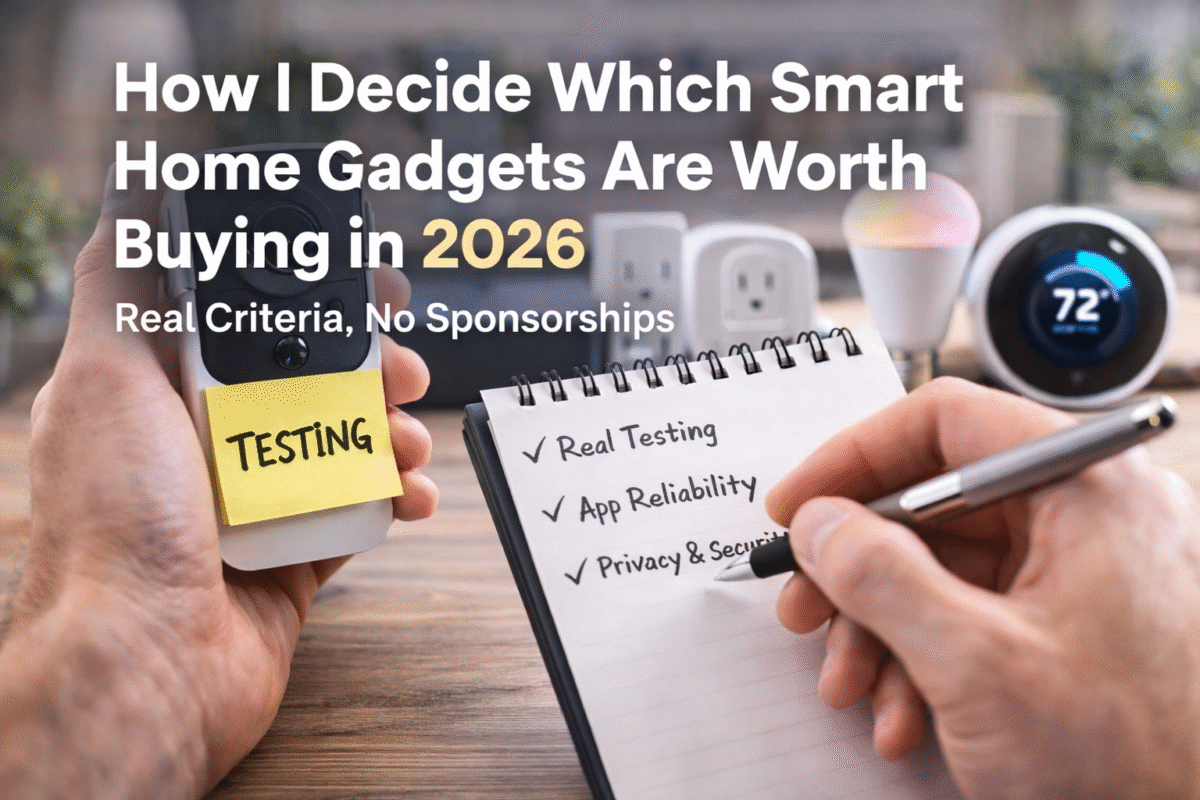
How to Choose Smart Home Gadgets That Are Worth Buying in 2026
How to choose smart home gadgets is one of the most common questions I get from readers who feel overwhelmed by hype, sponsored reviews, and conflicting opinions online.
In 2026, smart home technology is everywhere — from AI-powered trash cans to robot vacuums that promise to replace deep cleaning. But not every “smart” device is actually useful, reliable, or worth your money.
This article explains exactly how I decide which smart home gadgets are worth buying, based on real testing, long-term use, and practical criteria — not sponsorships or brand deals.
I run MadeMeBuyItNow, where I review smart home devices, tech gadgets, and Amazon finds with one clear goal:
help people avoid wasting money on gadgets that look cool but don’t deliver.
If you’ve ever bought a smart device that ended up unused in a drawer, this guide is for you.
Why Most Smart Home Reviews Can’t Be Trusted
Before explaining my process, it’s important to understand why so many smart home reviews fail to help real buyers.
Many review sites prioritize:
- Sponsored placements over real testing
- Short-term impressions instead of long-term reliability
- Feature lists copied from manufacturer descriptions
That’s how we end up with devices that look impressive on paper but fail in daily use.
On MadeMeBuyItNow, I follow a different approach — one built on:
- Hands-on evaluation
- Real-life usage scenarios
- Buyer-focused decision criteria
This approach aligns with Google’s EEAT principles:
Experience, Expertise, Authoritativeness, and Trustworthiness.
My Core Philosophy for Evaluating Smart Home Gadgets
I don’t start by asking, “What’s trending?”
I start with a more important question:
Does this gadget actually improve daily life, or is it solving a problem that doesn’t exist?
Every device I test goes through the same mental filter:
- Would I keep this if it wasn’t sent to me?
- Would I recommend this to family or friends?
- Would I buy this again with my own money?
If the answer to any of those is “no,” the gadget doesn’t make the cut.
This philosophy is the foundation behind all my smart home content, including:
📌 Related Smart Home Testing Guides
Criteria #1: Does the Gadget Solve a Real Problem?
The first thing I evaluate is simple:
What problem does this smart home gadget actually solve?
Many products add “smart” features without adding real value.
If a device complicates a task instead of simplifying it, it fails immediately.
For example:
- A smart trash can must improve hygiene and convenience — not just open automatically.
- A robot vacuum must reduce cleaning time — not require constant babysitting.
This is why I compare products deeply, like in my breakdown of
Xiaomi vs Dyson cordless vacuums, where real-world performance matters more than brand hype.
Criteria #2: Setup Time and Daily Usability
A smart home gadget should not feel like a second job.
I carefully evaluate:
- Initial setup time
- App clarity and stability
- How often the device needs manual intervention
If a device requires constant resets, complicated automations, or unreliable apps, it doesn’t qualify as “smart.”
This usability-first mindset applies across all categories — from power accessories like the
UGREEN 160W GaN Charger to full smart home ecosystems.
Explore More Trusted Tech Content
Browse more in-depth reviews and buying guides:
📲 Follow Us for Real Smart Tech Testing
We share daily smart home finds, honest reviews, and real-world testing — no hype.
- 🎥 TikTok
- 📘 Facebook Page
- 👥 Facebook Group

How I Evaluate Smart Home Gadgets Beyond the First Impression
Most smart home gadgets perform well during the first few hours or days.
That’s exactly why first-impression reviews are misleading.
When I evaluate smart home gadgets worth buying in 2026, I focus on how the device behaves after the novelty wears off.
This means testing devices across multiple real-life scenarios, not just controlled conditions.
Short-Term Performance vs Long-Term Reality
A smart device that works perfectly on day one can become frustrating after two weeks.
I deliberately separate testing into two phases:
- Initial phase (first 48–72 hours): setup, learning curve, app stability
- Extended phase (7–30 days): reliability, automation consistency, maintenance
During the extended phase, I track:
- How often the device disconnects
- Whether automations fail silently
- If notifications become annoying instead of helpful
This approach is critical when evaluating products like robot vacuums, security devices, and AI-powered gadgets that rely on software updates.
Identifying Common Failure Points in Smart Home Gadgets
Every category of smart home device has predictable weak spots.
Part of my testing process is identifying these early so readers know what to expect.
For example:
- Robot vacuums: navigation errors, app crashes, inconsistent mapping
- Smart plugs: Wi-Fi instability, delayed response times
- AI-powered devices: overpromised features that depend on cloud processing
Instead of ignoring these issues, I highlight them clearly — even when the device performs well overall.
This transparency builds trust and aligns with Google’s expectation for honest, experience-based content.
🔍 Real Comparisons, Not Marketing Claims
I rely heavily on side-by-side testing, like in this detailed comparison:
Comparisons reveal trade-offs that spec sheets never show.
Ecosystem Compatibility: Alexa, Google Home, Apple HomeKit
One of the biggest mistakes buyers make is ignoring ecosystem compatibility.
A smart home gadget can be excellent on its own but frustrating inside a mixed ecosystem.
I always test:
- Voice command reliability
- Automation delays across platforms
- Feature limitations depending on ecosystem
Some devices advertise compatibility but limit advanced features unless you use a specific platform.
This matters especially for users building a long-term smart home setup rather than buying one-off gadgets.
Data Collection, Privacy, and Cloud Dependence
Privacy is no longer optional in smart home buying decisions.
As part of my evaluation process, I review:
- What data the device collects
- Whether features stop working without cloud access
- If local control is available
Devices that require constant cloud access for basic functions lose points immediately.
I’ve documented these concerns in depth here:
Software Updates and Brand Accountability
Smart home gadgets are not just hardware — they’re long-term software commitments.
I research each brand’s update history:
- How often firmware updates are released
- Whether updates fix issues or introduce new ones
- If older devices are abandoned quickly
Brands with poor update support rarely make my recommendation list, even if the hardware is solid.
This is especially important in categories like AI-powered devices and smart security.
Price vs Value: Why Cheaper Isn’t Always Better
I don’t judge smart home gadgets solely by price.
Instead, I look at value over time.
A cheaper device that fails or becomes obsolete within a year costs more than a reliable product with longer software support.
This value-based approach also explains why some Amazon finds make sense — and others don’t.
Discover More Tested Smart Tech
By the time a smart home gadget reaches my recommendation list, it has survived weeks of real-world use, failure testing, and ecosystem checks.
This process eliminates hype-driven products and highlights devices that actually improve daily life.
In the next section, I’ll break down how I compare smart home gadgets against each other, avoid impulse buying traps, and decide when a product is simply not worth purchasing.
.

3. My Real-World Testing Methodology (How I Test Smart Home Gadgets in Daily Life)
One of the biggest problems with online reviews today is that many “tests” never leave the box.
To truly explain how I test smart home gadgets, you need to understand that I don’t rely on
lab-only benchmarks, manufacturer demos, or short-term impressions.
Every device I recommend is tested in real homes, real routines, and real scenarios.
That’s the only way to uncover issues that don’t show up in polished marketing videos.
📆 Minimum Testing Period (Why Time Matters)
I never recommend a smart home gadget after a single day or weekend of testing.
Most products behave well during the first few hours — problems appear after repeated use.
- Minimum testing time: 7–14 days
- Extended testing: 30+ days for complex devices
- Firmware updates monitored: Yes
- Long-term reliability checked: Yes
This allows me to evaluate how the gadget performs after software updates,
power outages, Wi-Fi drops, and daily wear.
It’s a core part of how I test smart home gadgets responsibly.
🏠 Real-Life Scenarios I Simulate
Smart home devices should make life easier — not create new problems.
That’s why I test each product under realistic household conditions, including:
- Multiple users accessing the same device
- Voice commands with background noise
- App usage on different phones
- Automation triggers during busy hours
- Guest or family member interactions
If a device only works perfectly in ideal conditions, it doesn’t pass my test.
📶 Network Stress Testing (Wi-Fi, Bluetooth & Stability)
Connectivity issues are one of the most common reasons people abandon smart home gadgets.
That’s why network behavior is a critical pillar of how I test smart home gadgets.
I specifically test:
- Performance on both 2.4GHz and 5GHz networks
- Behavior during weak signal conditions
- Reconnect speed after Wi-Fi drops
- Bluetooth pairing reliability
- Cloud dependency vs local control
Devices that fail silently, disconnect frequently, or require constant resets are flagged immediately.
📱 App Experience & Usability Evaluation
A powerful gadget with a terrible app is still a bad product.
I evaluate apps using the same standards across brands and platforms.
Key app testing criteria include:
- Setup clarity for beginners
- Speed and responsiveness
- Logical menu structure
- Automation flexibility
- Stability across updates
If an app feels confusing, cluttered, or unreliable,
it directly impacts my final recommendation — no exceptions.
🔐 Privacy, Security & Data Handling
Smart home devices live inside your private space.
That makes security and privacy non-negotiable.
As part of how I test smart home gadgets, I review:
- Account security options (2FA, permissions)
- Data storage policies
- Cloud vs local processing
- Camera and microphone controls
- Transparency of privacy policies
If a brand hides critical privacy information or forces unnecessary cloud access,
that is clearly stated in my review.
⚙️ Failure Testing (What Happens When Things Go Wrong)
Real trust comes from knowing how a device behaves when it fails.
I intentionally simulate failure scenarios such as:
- Power outages
- Router restarts
- App crashes
- Lost internet connection
Devices that recover gracefully score much higher than those requiring manual reconfiguration.
⭐ Scoring & Final Evaluation System
Every product receives a balanced internal score based on:
- Ease of setup
- Daily usability
- Connectivity reliability
- App quality
- Privacy & security
- Value for money
This structured approach ensures consistency across all reviews
and reinforces transparency in how I test smart home gadgets.
If a product doesn’t meet my standards, I simply don’t recommend it — even if it’s popular.
Common Smart Home Gadget Testing Mistakes Most Reviewers Make (And Why I Avoid Them)
One of the biggest problems in the smart home space is that many reviews look helpful on the surface but are built on weak or incomplete testing. Over time, I’ve identified recurring mistakes that lead to misleading recommendations. Understanding these mistakes will help you instantly recognize low-quality reviews.
1. Testing a Smart Home Gadget for Less Than 24 Hours
Smart home gadgets rarely fail on day one. The real problems appear after repeated use: delayed automations, app crashes, firmware bugs, or unstable Wi-Fi connections. I never recommend a device unless it has been tested over multiple days and real-life scenarios.
2. Reviewing Only the Best-Case Scenario
Many reviewers test devices in perfect conditions: strong Wi-Fi, brand-new phones, and ideal environments. In reality, most homes have signal interference, mixed ecosystems, and shared networks. My testing intentionally includes average and suboptimal conditions.
3. Copy-Pasting Specifications Without Real Validation
Specs don’t tell you how a device behaves in daily use. Instead of repeating marketing claims, I validate performance through hands-on testing: response time, automation reliability, and long-term stability.
4. Ignoring Software and Firmware Updates
Some smart home gadgets improve significantly after updates—others get worse. I track how devices behave before and after firmware updates, because software support is just as important as hardware quality.
5. Never Testing Failure Scenarios
What happens when the internet drops? When the app logs you out? When voice assistants fail? These moments define whether a product is truly reliable, and they are always part of my evaluation process.
How I Decide If a Smart Home Gadget Is Truly Worth Recommending
After testing dozens of smart home devices, I use a final decision filter that determines whether a product earns a recommendation or gets rejected. This step protects readers from buying devices that look good on paper but fail in real life.
My Non-Negotiable Criteria
- Consistency: The device must perform reliably every day, not just occasionally.
- App Stability: A smart gadget is only as good as its app experience.
- Privacy Transparency: Clear policies and minimal data collection matter.
- Automation Reliability: Schedules and triggers must work without constant tweaking.
- Long-Term Value: The product must remain useful after the novelty wears off.
If a cheaper device performs just as well—or better—than a premium one, I say so. Price does not influence my recommendations; performance does.
This approach is why some popular gadgets never appear on my recommended lists, while lesser-known products often do.
Who Smart Home Gadgets Are Actually For (And Who Should Think Twice)
Smart home gadgets aren’t one-size-fits-all. Through testing, I’ve learned that the same device can be amazing for one user and frustrating for another.
Smart Home Gadgets Are Ideal For:
- Users with stable Wi-Fi networks
- People who value automation and convenience
- Homeowners or long-term renters
- Users comfortable managing apps and settings
You Should Be More Cautious If:
- Your internet connection is unstable
- You dislike frequent app updates
- You expect everything to work perfectly out of the box
- You are highly sensitive to data privacy concerns
Part of responsible reviewing is helping readers decide not to buy when a product doesn’t match their lifestyle.
How My Smart Home Gadget Testing Process Has Evolved Over Time
My testing process today looks very different from when I started reviewing smart home gadgets. Early on, I focused too much on features and not enough on reliability. Real-world use taught me that long-term performance matters far more.
Over time, I began extending test periods, tracking firmware changes, and incorporating reader feedback. Devices that initially impressed me sometimes failed weeks later, while others improved significantly with updates.
Today, my process prioritizes:
- Long-term usability
- Real household scenarios
- Cross-platform compatibility
- User frustration points
This evolution allows me to provide recommendations that remain accurate long after publication.
Transparency, Affiliate Links, and How This Site Is Funded
Some links on this site are affiliate links. If you purchase through them, I may earn a small commission at no extra cost to you.
This does not influence which products I recommend. Brands do not pay for placement, and many products fail my testing process and are never published.
My goal is simple: provide honest, experience-based smart home reviews that help readers make confident buying decisions.
Frequently Asked Questions About Smart Home Gadget Testing
How long should a smart home gadget be tested?
Ideally, several days to multiple weeks. Short tests rarely reveal reliability issues.
Can smart home devices work without the internet?
Some basic functions may work locally, but most advanced features require internet access.
Are expensive smart home gadgets always better?
No. Many mid-range devices outperform premium products when evaluated long-term.
How often do smart home gadgets receive updates?
It depends on the brand. Regular updates are a strong indicator of long-term support.
🔥 Join 120,000+ Smart Shoppers!
Get exclusive gadget deals, viral Amazon finds and tech reviews before they trend. Only the best — straight to your inbox every week 🚀